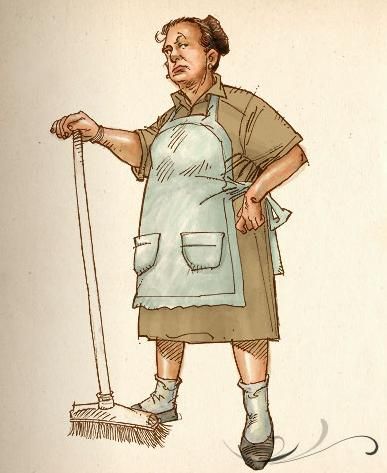
While this incredibly complex novel is told predominately through the experiences of the male characters, it is the female characters of this novel that really hold their small society together. Ursula, the oldest and arguably most important character as to the development and survival of Macondo’s “root family”, has witnessed several generations due to her unnatural longevity. It is Ursula that brings life, and ultimately death, to the small, secluded world that is Macondo.
In just the very first few pages of the novel, the novel states that Ursula and the children “broke their backs in the garden, growing banana and caladium…” while Jose Arcadio Buendia spent his time holed up in the lab and talking to himself (p.4). The more J.A.B. became enraptured with the gypsies, the more Ursula struggled to make things hold on her own.
J.A.B. attempts to establish civilization outside of Macondo, and is thwarted by the swamp, and decides that the search is frivolous. Not one to giving up easily, Ursula trudges through these swamps and finds traders, furthering the development of their little town. Along with the town growing, Ursula takes even more responsibility of the growing Buendia family. Ursula is responsible for the now blossoming Macondo, inside and out. However, these actions are told to us through our narrator, as Ursula is treated less than compared to the “patriarch of Macondo”, J.A.B.
In chapter 13 is when Ursula’s health begins to decline. She is starting to realize that the “light” in Macondo is “going out”, as represented by her blindness. However, no one else in the household is aware of her blindness as she is able to move just as she did previous to losing her vision. It is also around this point that Amaranta passes away, leaving Ursula in this depressed, bed-ridden state for many years. However, even during her perpetual mourning, she tells stories of the family and history of Macondo, deepening the roots of their society. Chapter 15, possibly one of the most complex parts of the novel, is when Jose Arcadio Segundo is nowhere to be found, just as Jose Arcadio Buendia all of those years ago. Ursula is finally able to see that her family is doomed “..as if the world were repeating itself.”, and Macondo itself is aging rapidly, just as Ursula is (p.298).
Ursula lives to be well over 120 years before passing, and before she does becomes almost childlike due to senility. Representing Macondo’s dilapidated state, she is reverting back into the past, so small and cut off from the rest of the world, as if Macondo were the only civilization on Earth. When she is buried, its easy to assume she takes the chances of Macondo’s survival with her. She is buried on Good Friday, the commemoration of Jesus Christ’s crucifixion and his death at Calvary, which implies that Ursula was seen as the “savior” of Macondo’s two and half centuries of existence. The townspeople start to experience what they only assume to mean death omens and the entire town begins to fall to disarray.
Ursula Iguran, through her very powerful presence, her undying dedication to family, and her ability to succeed where her male counterparts fail, can definitely be read as the true creator and founder of Macondo, for she mothered and provided for her family for generations.
– Rabassa, Gregory, translator. One Hundred Years of Solitude. By Gabriel Garcia Marquez, Harper Perennial, 1967.
 Reflections